The Challenge
Despite being a functional monetization tool, our legacy “Bait Ads” module (a sticker-drawing mechanic) was a major friction point. User feedback and support tickets identified it as a crude experience—full-screen ads triggered without warning, a disconnected design, and no clear value for the effort.
The core problem was twofold:
- Lack of Persistence: Progress was stored locally, meaning users lost years of “collecting” when switching devices.
- Dead-End UX: There was no ultimate goal. Users collected stickers but received no tangible reward, leading to manual “support-driven” interventions to keep the most loyal users engaged.
The goal was to transform this high-friction module into a transparent, brand-aligned system that could serve as a foundation for future app-wide gamification.
My Strategy & Actions: Building the Reward Loop
As the PM, I architected a shift from a “forced ad” model to a voluntary Reward Economy. My strategy focused on resourcefulness—repurposing existing assets to build a high-impact storefront with minimal dev effort:
- AI-Assisted Prototyping (Vibe Coding): To accelerate the discovery phase, I built the initial prototype of the Reward Store myself using Vibe Coding. This functional prototype served as a high-fidelity wireframe for the design team, significantly reducing the handoff friction and allowing us to “feel” the UX before a single line of production code was written.
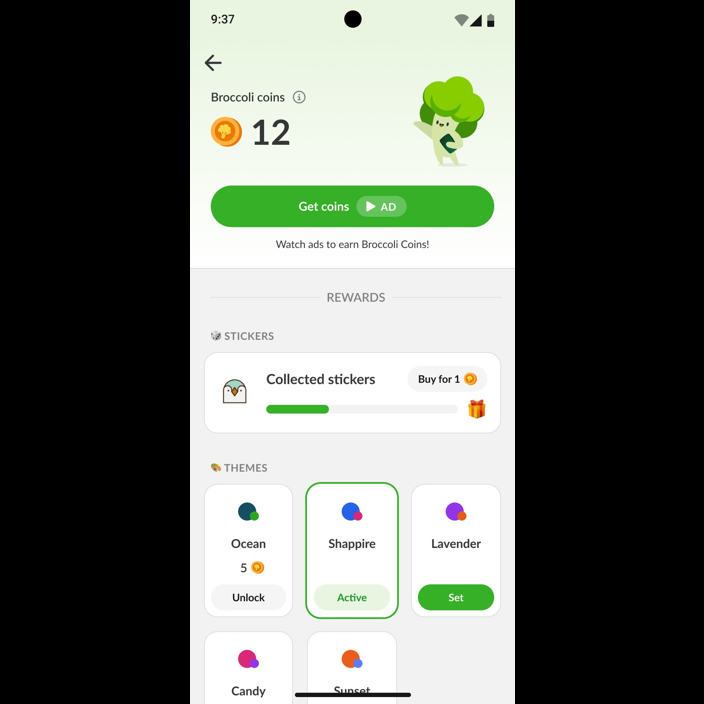
- Marketplace Consolidation: I identified “dark” features—custom themes, fonts, and ad-free toggles—that were buried in settings. By consolidating them into a unified Reward Store, we gave these existing assets a new purpose as aspirational goals.
- Introducing Broccoli Coins: To soften the perception of monetization, I introduced a brand-hero-themed currency. This shifted the user’s mental model from “watching an ad for a random draw” to “earning currency to buy specific rewards.”
- User-Centric Gacha Logic: I implemented a “no-replacement” drawing mechanic. Once a user earned a sticker, it was removed from the pool. This turned a frustrating gamble into a visible progress bar toward completion.
- Strategic Tiering & Risk Management: To protect our revenue, I designed a Regional Tiering system. High-value rewards (like ad-free time) were restricted in premium markets (Tier 1), ensuring we didn’t cannibalize our most profitable ad streams.
The Results: Lessons in Engagement
The pivot to Broccoli Coins was a strategic success in “de-risking” our monetization and building a scalable infrastructure:
- Infrastructure for Growth: By introducing the currency model, we established a “Golden Path” for future features. We can now incentivize any high-value action—like daily streaks or task completion—using a familiar reward loop.
- Improved Discovery: Features that were previously invisible (themes and fonts) saw a significant uptick in engagement simply by being positioned as rewards within the new UI.
- Data Integrity: Moving the collection state from local storage to user accounts eliminated the “lost progress” complaints, securing the long-term loyalty of our “Collectors” segment.
- Reality Check: While the project didn’t immediately spike overall ad revenue, it drastically improved qualitative sentiment. We proved that monetization doesn’t have to be crude to be effective.
Summary
The Broccoli Coins project was a lesson in Product Resourcefulness. We didn’t need to build new “prizes” from scratch; we needed a better system to deliver the ones we already had. By using Vibe Coding to bridge the gap between idea and design, we successfully transformed a dead-end feature into a scalable framework for future growth.