The Challenge
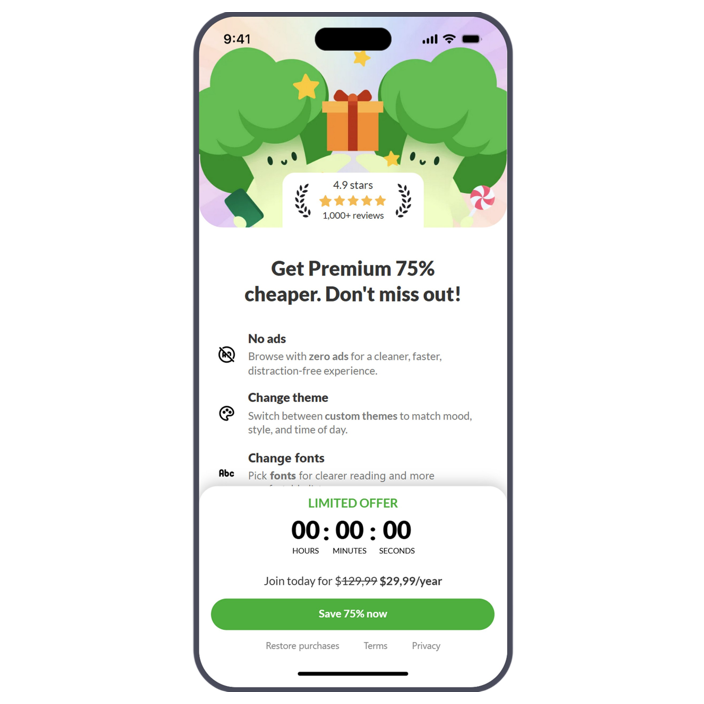
Our premium sales management was a major operational bottleneck. Every UI tweak, pricing update, or CTA change on the paywall required manual development work and a full app store release cycle. This was not only expensive but also prevented us from experimenting at the speed a modern mobile app requires.
Furthermore, our premium logic was fragmented. We maintained two separate, complex codebases for Android and iOS to handle subscriptions, trial periods, and entitlement syncing. This duplication of effort, combined with a reliance on a “Lifetime” payment model, was hitting a profitability ceiling. We needed to unify our cross-platform logic and move toward a more sustainable LTV (Life Time Value) model.
My Strategy & Actions: Engineering for Growth
As the Product Manager, I led the transition from a legacy, hard-coded system to a modern, flexible infrastructure:
- Strategic “Buy vs. Build” Decision: Instead of maintaining expensive, proprietary code for in-app billing and entitlement validation, I decided to implement RevenueCat. This offloaded the complexity of Apple and Google billing updates (StoreKit/Billing Library) and provided instant access to advanced A/B testing.
- Architecture Consolidation (Kotlin Multiplatform): To solve the issue of fragmented frontend logic, I spearheaded the development of a new library using Kotlin Multiplatform (KMP). By moving the core logic, validation rules, and promotion triggers into a shared KMP module, we ensured 100% consistency between iOS and Android while keeping the UI layer native and performant.
- Remote Paywall Management: I enabled the team to manage paywalls remotely. By decoupling the business logic from the app’s hard-coded frontend and implementing Revenue Cat, we empowered non-technical stakeholders to test pricing and designs without waiting for a developer’s sprint.
The Results & Strategic Impact
The project wasn’t just a technical upgrade; it was a fundamental shift in how the company makes money:
- 10x Growth in Subscriptions: Detailed cohort analysis revealed that the Lifetime plan was unsustainable. We pivoted our focus to annual subscriptions, leading to a 1000% increase in subscription volume. While this caused a controlled short-term revenue dip, it secured significantly higher long-term profitability and LTV.
- Operational Efficiency: We eliminated the need for duplicate frontend logic and a dedicated backend. The cost of maintaining the system dropped significantly, and the time-to-market for pricing changes went from weeks to minutes.
- Unified Codebase: Using KMP reduced the surface area for “platform-specific” billing bugs, allowing our mobile engineers to focus on building features rather than debugging store integrations.
- Data-Driven Agility: With the ability to run A/B tests on the fly, we can now optimize the sales funnel in real-time. We no longer guess which pricing or CTA works - we know.
Summary
The Premium Lib Multiplatform project was a masterclass in Technical Product Management. By choosing the right tools (RevenueCat) and the right architecture (KMP), we transformed a rigid, expensive process into a lean, high-growth engine. This pivot proved that the right technical foundation is the ultimate enabler for business model innovation.