The Challenge
Despite being a market leader, we saw a gap between two user intents: meal planning and shopping. Users were jumping between recipe apps, notes, and Listonic, losing momentum along the way.
The primary business goal was to create a powerful marketing hook (Marketing-Driven Development) to rejuvenate the brand. Secondary goals included increasing session time and testing a new hybrid monetization model to bridge the gap between our Freemium and Premium tiers.
My Strategy & Actions: Loops, Logic, and “Shape Up”
To navigate the uncertainty of AI, I combined rapid technical prototyping with a rigorous feedback framework inspired by the Shape Up methodology:
- Hybrid Monetization Architecture: I designed a “Value-Exchange” gate. Freemium users encounter a rewarded video ad after every few messages to unlock further interaction, while Premium users enjoy unlimited access. This turned the AI Assistant into a direct driver for subsciption value.
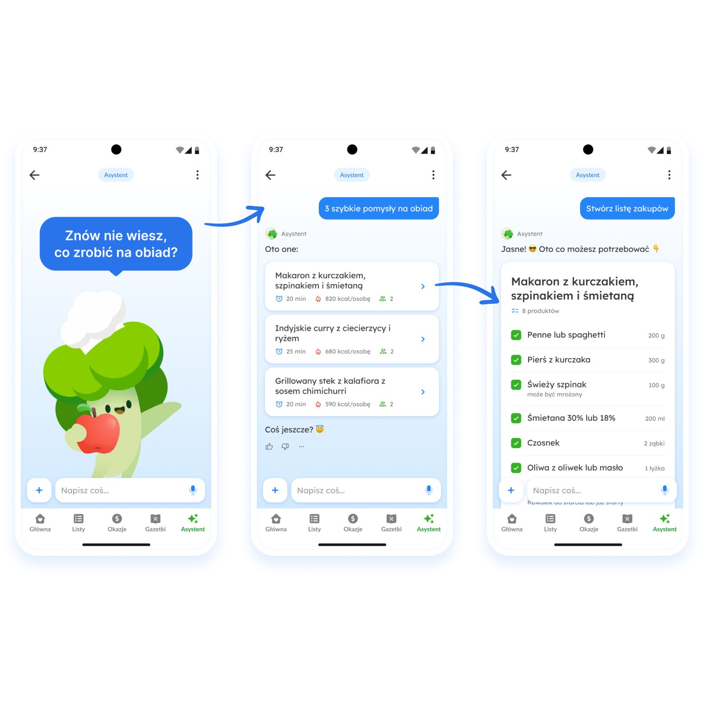
- Function Calling & Context Awareness: Instead of a generic chatbot, we implemented Function Calling. The LLM model can access the context of the user’s current list and history, allowing it to provide personalized advice like: “You bought eggs yesterday, do you want to add flour for the pancakes we discussed?”
- The “Dopamine Loop” via Suggestions: To drive engagement, I introduced personalized Next-Step Suggestions. Based on the conversation context (e.g., a meat-heavy recipe), the model proactively suggests continuations like “Show me a vegan alternative” or “What’s the wine pairing for this?”.
- Validation via “Amazon-Style” PR: Before writing code, I wrote an internal Amazon-style Press Release and surveyed 30 internal stakeholders. I followed this with external surveys (50+ users) and continuous feedback loops during the Design and Dev phases, keeping the team “under the current” of user needs.
- Vibe Coding the Logic: I personally prototyped the core interaction logic using Vibe Coding, which allowed the team to work with a functional “wire-app” rather than text PRD.
The Results: Beyond the Marketing Hook
The AI Assistant exceeded its “marketing hook” status, delivering significant uplift in core product metrics:
- Conversion Powerhouse: Users who engage with the AI Assistant show a 30% higher conversion rate to Premium compared to non-users.
- Doubled Engagement: The average session time for AI-active users is nearly 2x higher than the app average.
- Usability North Star: We tracked the “AI-to-List” conversion (percentage of AI-generated items added to real lists) as our primary utility metric, ensuring the assistant provides real value, not just entertainment.
- The “Surprise” Feedback Loop: Interactions within the chat have become a goldmine for R&D. By analyzing which suggestions users click and what they ask about, we gain direct insights into feature gaps across the entire Listonic ecosystem.
Summary
The AI Shopping Assistant proved that “Marketing-Driven Development” can lead to deep product value if executed with the right framework. By focusing on Context-Awareness and a Hybrid Monetization model, we didn’t just build a chatbot—niether did we just build a tool. We built a conversion engine that pays for itself while providing a roadmap for the future of the app.